
A biochemistry analyser is one of the biggest single investments a diagnostic lab makes – and one of the hardest to reverse once reagents, service contracts, and staff training are built around it. Whether you’re setting up a new lab, replacing an ageing machine, or scaling a growing pathology practice, the choice you make here will shape your turnaround times, your reagent costs, and your reputation with referring physicians for years to come.
This guide walks through the practical questions worth asking before you sign a purchase order, written specifically with the realities of Indian labs in mind – variable patient loads, power fluctuations, distributed service networks, and tight margins on a per-test basis.
Why the Right Biochemistry Analyser Decision Matters
Every biochemistry analyser looks similar on a spec sheet: throughput numbers, a parameter list, a footprint diagram. But two labs running the “same” test volume can have very different experiences with the same machine, depending on their sample mix, their staffing, and how well the analyser’s reagent ecosystem fits their budget.
Getting this decision right isn’t just about buying a machine – it’s about choosing a testing partner you’ll depend on daily. A wrong fit shows up months later as backlogs during peak hours, unplanned reagent costs, or downtime you can’t get serviced quickly enough.
Semi-Automated vs Fully Automated: Which Fits Your Lab’s Volume
This is usually the first fork in the road, and it’s worth resisting the instinct to simply buy “the bigger machine.”
1. Semi-Automated Analysers
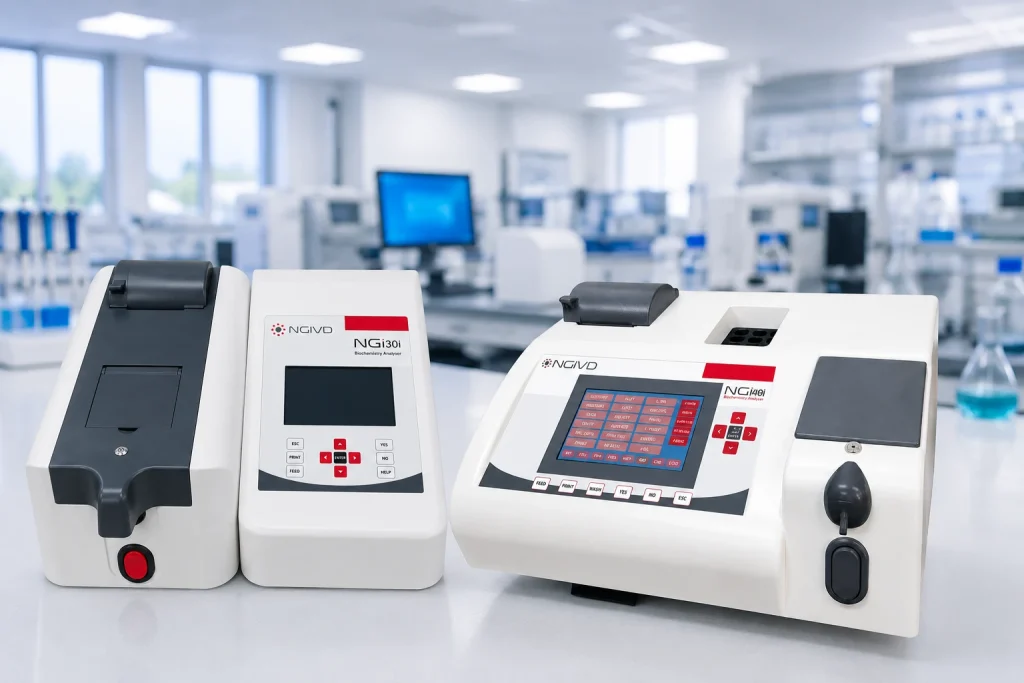
Semi-automated analysers require a technician to handle pipetting, sample loading, and sometimes reagent mixing, while the instrument handles the photometric reading and calculation. They suit labs running lower daily volumes – typically smaller diagnostic centres, nursing homes, or clinics doing a few dozen to a couple hundred tests a day. The upfront cost is lower, the footprint is smaller, and the learning curve for staff is shorter.
The trade-off is throughput and consistency: results depend partly on operator technique, and a busy morning rush can create bottlenecks.
2. Fully Automated Analysers
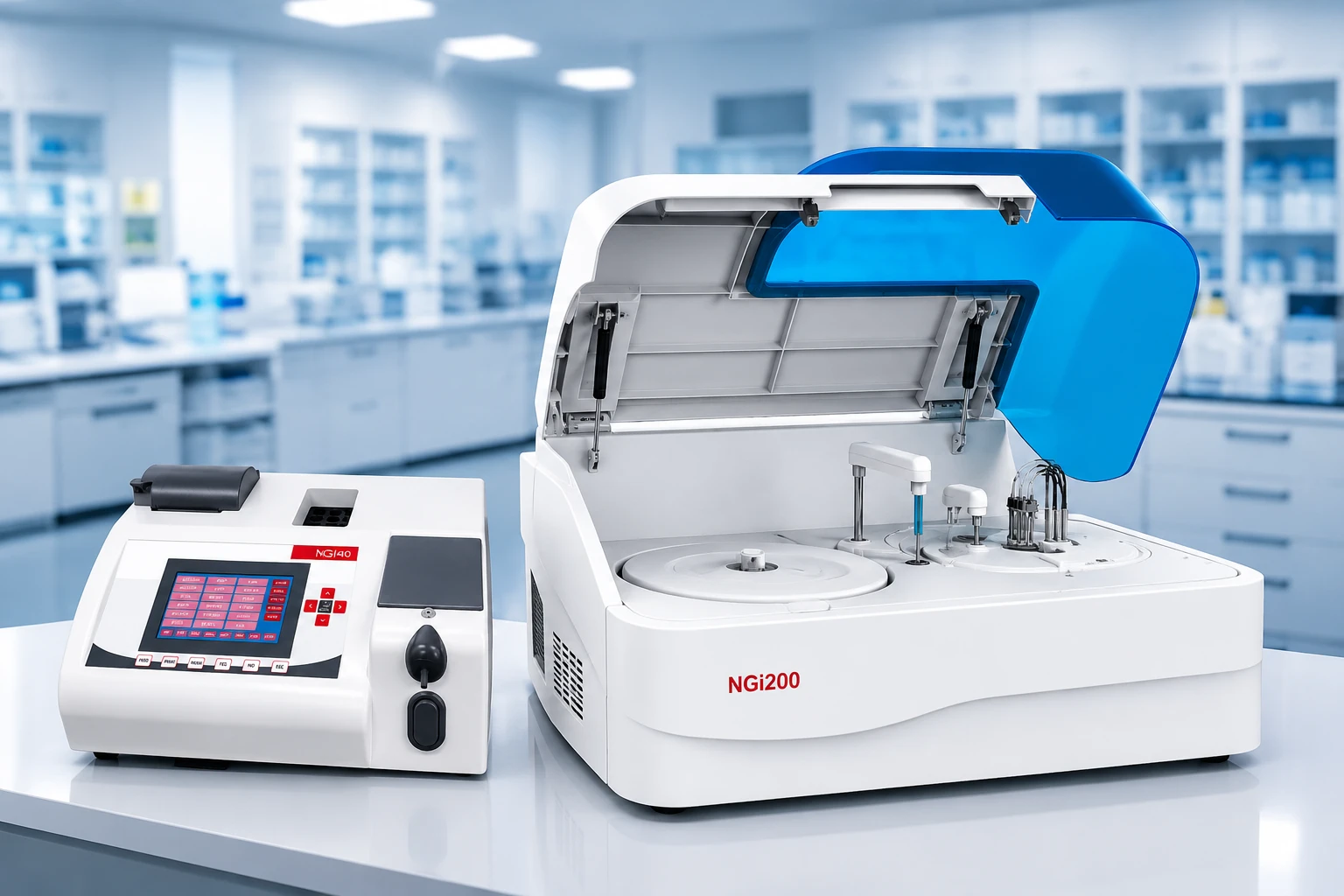
Fully automated analysers handle sample loading, reagent dispensing, mixing, incubation, and reading with minimal manual intervention, and can run hundreds to well over a thousand tests per hour depending on the model. They make sense once daily volumes and turnaround-time pressure justify the higher upfront cost – typically mid-size to large labs, hospital laboratories, and reference labs serving multiple collection centers.
The right question isn’t semi or fully automated in the abstract – it’s what does my average daily sample count look like on a peak day, six months from now, not just today? Buying for current volume alone is one of the most common sizing mistakes labs make.
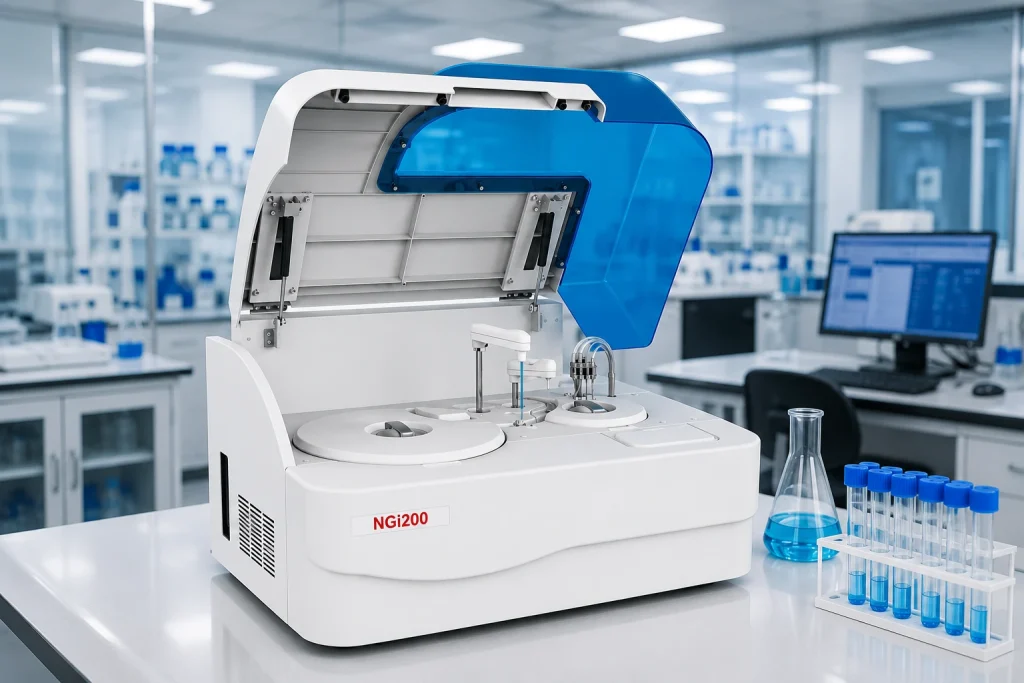
Throughput and Test Menu: Matching the Machine to Your Daily Workload
Beyond the semi/fully automated split, look closely at:
- Tests per hour at realistic (not marketing-brochure) conditions
- Parameter menu breadth – does it cover your core panels (liver function, kidney function, lipid profile, glucose, electrolytes) plus any special parameters your referring doctors ask for
- STAT/priority sample handling – can urgent samples jump the queue without disrupting the batch
- Sample and reagent capacity – how often staff need to intervene during a run
A machine rated for 400 tests/hour sounds impressive, but if your lab rarely exceeds 150 tests/hour even during peak load, you may be paying for capacity – and a larger reagent commitment – you’ll never use.
Open System vs Closed Reagent System
This single decision affects your cost per test for the entire life of the instrument.
Closed (proprietary) reagent systems lock you into the manufacturer’s reagents. Pricing is predictable but usually higher, and you lose negotiating leverage over time.
Open reagent systems let you source compatible reagents from multiple manufacturers, which can meaningfully lower your cost per test – but only if you verify reagent compatibility and stability data for each parameter you plan to run, rather than assuming “open system” means every reagent will perform identically.
Ask any vendor directly: is this a fully open system, a partially open system (open for some parameters, closed for others), or closed? Get this in writing, not just verbally confirmed during a sales visit.
Accuracy, Precision and Quality Control
Numbers on a screen mean nothing if they’re not reliable. Before buying, ask to see:
- Method comparison and correlation data against a reference analyser
- Coefficient of variation (CV%) figures for both intra-assay and inter-assay precision
- Linearity ranges for your most-run parameters
- Internal quality control (IQC) and external quality assessment (EQA) support built into the software
A demo run on your own samples not just the vendor’s control sera – tells you far more than a spec sheet ever will. Insist on it before committing.
Regulatory Certifications to Verify
In the Indian market, certification isn’t just paperwork – it’s your assurance that the manufacturer has processes in place to catch problems before they reach your lab. At minimum, confirm:
- CDSCO registration for the analyser and its reagents, as applicable under current Indian medical device rules
- ISO 13485:2016 – the quality management standard specific to medical device manufacturing
- ISO 9001:2015 and ISO 14001:2015 – general quality and environmental management systems
- cGMP compliance at the manufacturing facility
Ask to see certificates, not just claims on a brochure. A manufacturer confident in its quality systems will produce documentation without hesitation.
Total Cost of Ownership, Not Just Purchase Price
The sticker price of the analyser is often the smallest number in a multi-year cost calculation. Build a proper total-cost-of-ownership picture that includes:
- Reagent cost per test at your expected volume
- Annual Maintenance Contract (AMC) or Comprehensive Maintenance Contract (CMC) pricing after warranty ends
- Calibrator and control costs
- Consumables (cuvettes, sample cups, tubing) and their local availability
- Estimated downtime cost if a critical part isn’t stocked locally
A lower-priced analyser with expensive proprietary reagents can easily cost more over three years than a slightly pricier machine with a competitively priced reagent menu.
After-Sales Support, AMC and Spare Parts Availability
This is where many purchase decisions are won or lost in practice, especially outside major metros. Before buying, ask:
- Where is the nearest service engineer based, and what’s the realistic response time for a breakdown call?
- Are critical spare parts stocked in India, or shipped from abroad when needed?
- Is remote diagnostics or software support available to reduce on-site visit dependency?
- What’s covered under warranty versus what triggers an AMC/CMC charge?
A day of analyser downtime doesn’t just cost revenue – it costs referring-physician trust that’s hard to rebuild.
Space, Power and Infrastructure Requirements
Practical, easy to overlook, and expensive to fix after installation:
- Bench space and load-bearing requirements
- Power stability – does the analyser need a dedicated UPS or voltage stabilizer given local power quality?
- Water purification requirements for certain analyser types
- Ambient temperature and humidity tolerances, particularly relevant for labs without full climate control
Vendor Reliability: What to Ask Before You Sign
Before finalizing, it’s worth asking the manufacturer directly:
- How long has this specific analyser model been in the field, and how many installations exist in India?
- Can you connect me with two or three existing customers running similar test volumes?
- What’s your in-house manufacturing versus outsourced-assembly split – does that affect spare parts lead time?
- What’s your process if a reagent lot fails quality control after I’ve already purchased stock?
Vendors confident in their product and support network answer these questions plainly and quickly.
Quick Checklist Before You Buy
- Daily and peak-hour test volume estimated realistically, with room for growth
- Semi-automated vs fully automated decision matched to that volume
- Full parameter menu covers your core and specialty panels
- Reagent system (open/closed) confirmed in writing, with per-test cost calculated
- Method comparison, CV%, and linearity data reviewed – ideally with a live demo on your own samples
- CDSCO registration, ISO 13485, ISO 9001/14001, and cGMP compliance verified with documentation
- Three-year total cost of ownership calculated, not just purchase price
- AMC/CMC terms and local spare-parts availability confirmed
- Space, power, and infrastructure requirements checked against your lab’s actual setup
- References from existing customers with similar volume contacted directly
Why This Matters for Labs Working With NGIVD
NGIVD manufactures its biochemistry and hematology analysers at its ISO 9001:2015, ISO 14001:2015, ISO 13485:2016 and cGMP-certified facility in IMT Manesar, Haryana, with in-house R&D and manufacturing across multiple production lines – backed by support from BIRAC and the Department of Biotechnology. For labs going through the checklist above, that means certifications, manufacturing traceability, and local support are already built into the conversation from day one, rather than something to chase down after the sale.
If you’re currently evaluating a biochemistry analyser for your lab, get in touch with the NGIVD team or explore the full Analysers range to see specifications and reagent compatibility for yourself.
Frequently Asked Questions (FAQ)
What is a biochemistry analyser used for?
A biochemistry analyser is laboratory equipment used to measure biochemical parameters in biological samples. Depending on the system and reagents used, it can support tests such as glucose, urea, creatinine, liver-function parameters, lipid parameters and other clinical chemistry assays.
Which is better: semi-automatic or fully automatic biochemistry analyser?
Neither is universally better. Semi-automatic systems may be suitable for smaller or moderate-volume laboratories requiring flexibility and lower initial investment, while fully automatic systems may be more appropriate for higher workloads and laboratories seeking greater automation.
What should I check before buying a biochemistry analyser?
Check throughput, test menu, methodology, sample volume, reagent requirements, analytical performance, calibration, QC capabilities, automation, LIS connectivity, maintenance, service support, regulatory documentation and total cost of ownership.
How important is analyser throughput?
Throughput is important because it determines how effectively the analyser can handle your laboratory’s workload. However, the rated throughput should be considered alongside actual workflow, peak workload, test mix and operator requirements.
How much does a biochemistry analyser cost in India?
The price varies significantly depending on the analyser type, automation level, throughput, specifications and included accessories or services. Instead of comparing purchase price alone, laboratories should compare total cost of ownership, including reagents, consumables, maintenance and service.
What is total cost of ownership for a biochemistry analyser?
Total cost of ownership includes the initial instrument investment as well as recurring expenses such as reagents, calibrators, controls, consumables, maintenance, service, spare parts and other applicable operating costs over the equipment’s useful life.
Why is technical support important for a chemistry analyser?
Technical support can help with installation, operator training, troubleshooting, preventive maintenance and downtime management. Reliable local support can be particularly valuable when an analyser is central to daily laboratory operations.
Are biochemistry analysers and clinical chemistry analysers the same?
The terms are commonly used interchangeably in laboratory settings. Both generally refer to instruments designed to perform biochemical/clinical chemistry measurements, although specific capabilities vary by platform.