

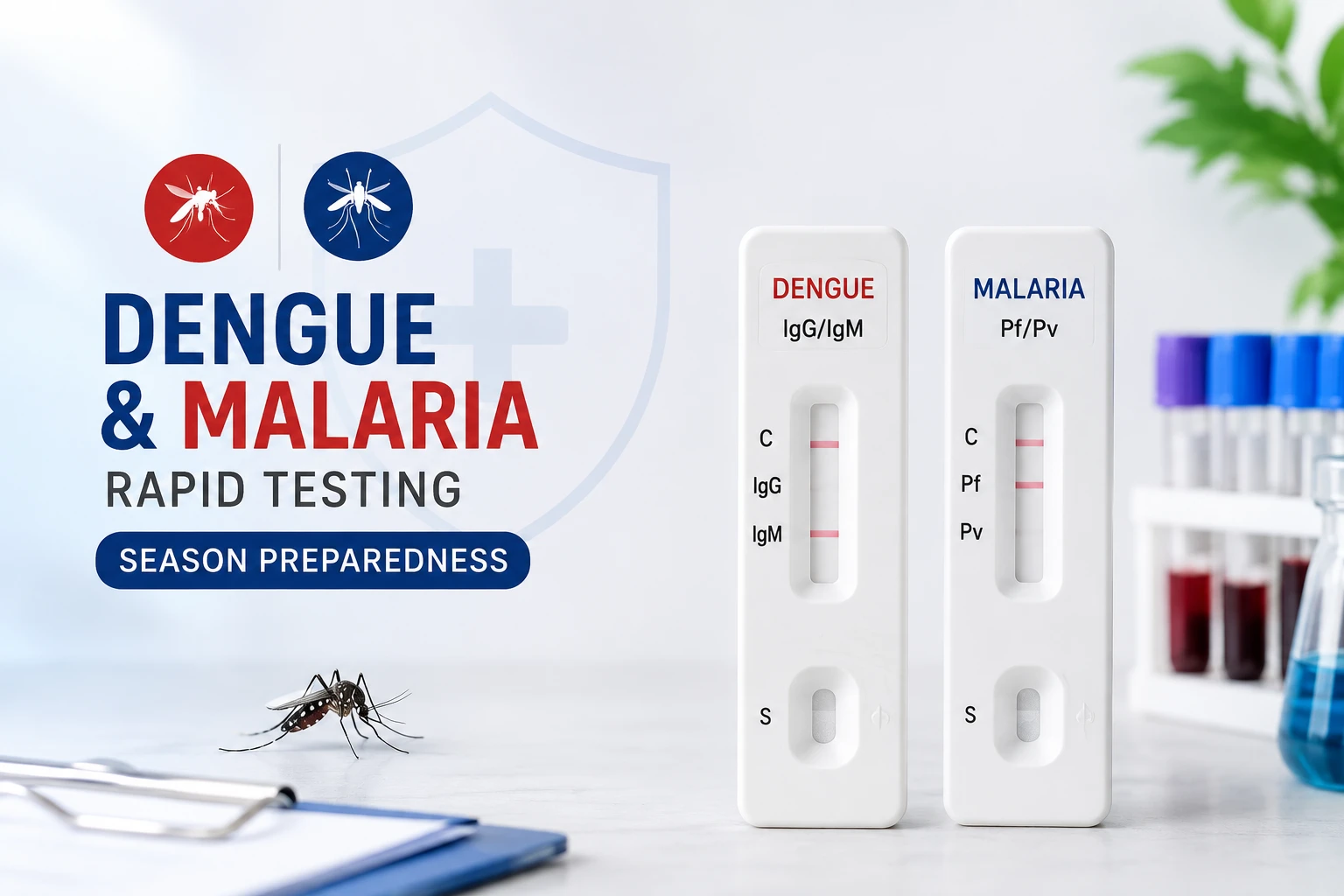
Every year, the same pattern repeats across Indian diagnostic labs: as the monsoon sets in and stagnant water spreads across cities and villages, fever cases surge, and labs that were running a handful of vector-borne disease tests a week suddenly find themselves running dozens a day. Labs that prepare their rapid testing stock, staff, and storage ahead of this surge handle it smoothly. Labs that don’t end up scrambling for kits, fielding anxious patients, and risking result quality under pressure.
This guide covers what “season preparedness” actually means for dengue and malaria rapid testing – from understanding what each test detects, to the storage and quality-control details that quietly determine whether your results are trustworthy when it matters most.
Why Season Preparedness Matters for Diagnostic Labs
Dengue and malaria cases in India follow a fairly predictable seasonal curve, typically climbing from June and peaking between August and November as monsoon rainfall creates breeding conditions for both the Aedes mosquitoes that spread dengue and the Anopheles mosquitoes that spread malaria. Labs that wait until the surge begins to check their rapid test stock often discover shortages, expired lots, or storage conditions that have quietly degraded kit sensitivity over the off-season.
Preparedness isn’t just a supply-chain exercise – it directly affects diagnostic accuracy. A rapid test stored above its specified temperature range for weeks can still look fine on the shelf while giving unreliable results at the bench.
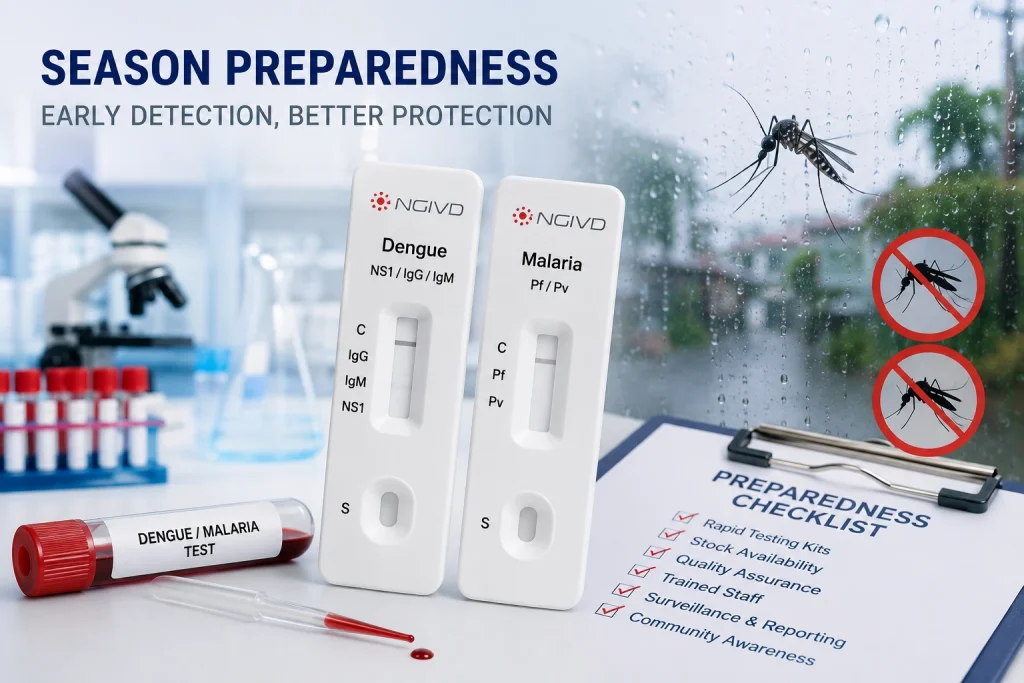
Understanding Dengue Rapid Tests: NS1, IgM and IgG
Dengue diagnosis relies on different markers depending on how many days a patient has been symptomatic, which is why most labs stock a combination test rather than a single marker.
1. NS1 Antigen (NS1 Ag) Test
The NS1 (non-structural protein 1) antigen appears early in infection and is generally most reliably detected within the first few days of fever onset – typically up to around day 6–9 depending on whether the infection is primary or secondary. An NS1-positive result during this window is a strong early indicator of active dengue infection, which makes it valuable for early clinical decisions.
2. IgM/IgG Antibody Test
As the NS1 window closes, antibody-based testing becomes more useful. IgM antibodies typically become detectable roughly four or more days after symptom onset and can persist for weeks to months, indicating a recent infection. IgG appears later and, when interpreted alongside IgM, helps distinguish a primary dengue infection from a secondary one – an important distinction since secondary infections carry a higher risk of severe dengue.
3. Combo NS1 + IgM/IgG Cassettes
Because the useful detection windows for NS1 and antibodies shift as illness progresses, combination cassette tests that screen for all three markers on a single device have become the practical standard for most Indian labs – they reduce the chance of a false negative simply because a patient presented on the “wrong” day for a single-marker test.
Understanding Malaria Rapid Diagnostic Tests
Malaria RDTs work differently, detecting parasite proteins rather than a host immune response, which means results are available essentially in real time relative to active infection.
1. HRP-2: Plasmodium falciparum-Specific
Histidine-rich protein 2 (HRP-2) is specific to Plasmodium falciparum (Pf), the species responsible for most severe and fatal malaria cases in India. An HRP-2 line detects current or very recent P. falciparum infection.
2. pLDH: Pan-Species Detection
Parasite lactate dehydrogenase (pLDH) is produced by all Plasmodium species, including P. vivax (Pv), which remains widespread across India. A combination HRP-2/pLDH test allows a lab to both confirm falciparum infection specifically and flag non-falciparum infections that would otherwise be missed by an HRP-2-only device.
Why Symptom Overlap Makes Rapid Testing Essential
Dengue and malaria present almost identically in their early stages – high fever, body ache, headache, chills — which makes clinical diagnosis alone unreliable, especially during peak season when both diseases are circulating in the same population. This is precisely why combined dengue-malaria testing protocols, or parallel panels run on the same visit, have become standard practice in many labs: a physician working purely from symptoms cannot safely tell the two apart, but a lab can, within minutes.
Building a Season Preparedness Checklist for Your Lab
A few weeks before the season typically picks up in your region is the right time to review:
- Stock levels against last year’s peak-week volume, with a buffer for an unusually severe season
- Lot expiry dates across current stock, ordering fresh lots rather than running down old inventory right as demand spikes
- Staff refreshers on correct sample application, read-time windows, and result interpretation – a surge in daily test volume is exactly when technique shortcuts creep in
- A clear confirmatory-testing pathway for reporting positive or ambiguous rapid results onward to ELISA or PCR/microscopy where clinically indicated
Storage, Cold Chain and Kit Validation: Where RDTs Go Wrong
Rapid test cassettes are more sensitive to their storage environment than many labs realise. A few practical safeguards:
- Store kits within the manufacturer’s specified temperature range at all times, including during transport from distributor to lab – not just once they’re on the shelf
- Avoid storing kits near windows, direct sunlight, or areas with high humidity, both common issues during monsoon in un-air-conditioned storage rooms
- Run a positive and negative control check on each new lot before it goes into patient use, rather than assuming lot-to-lot consistency
- Track opened-pouch usage windows carefully – cassette performance can degrade once removed from its sealed foil pouch
Regulatory and Quality Considerations
For labs operating in India, a few checkpoints are worth building into procurement and reporting:
- Verify that dengue and malaria RDTs are validated against the diagnostic algorithms recommended for Indian conditions, including guidance issued through national vector-borne disease control programmes
- For malaria, a defined proportion of RDT-positive (and a sample of negative) results should ideally be cross-checked by microscopy as a quality-assurance measure, particularly in labs supporting public health reporting
- Confirm CDSCO registration status for any rapid test kit before it’s brought into routine use
Building Patient and Physician Trust During Peak Season
Speed matters during an outbreak, but so does communicating result limitations clearly. A rapid test result – positive or negative is a screening tool, not always the final word. Labs that clearly flag when a negative dengue NS1 result in a symptomatic patient warrants a follow-up antibody test a few days later, or when a malaria-negative RDT in a high-risk patient still merits microscopy confirmation, build long-term credibility with referring physicians precisely because they aren’t just handing over a cassette line and moving on.
Quick Season-Readiness Checklist
- Peak-season stock levels calculated against last year’s data, with a buffer
- All current lots checked for expiry before season onset
- Fresh lot ordered with adequate lead time, not during the surge itself
- Storage area checked for temperature and humidity compliance
- New lot control-tested before patient use
- Staff refreshed on technique, timing, and interpretation
- Confirmatory testing pathway (ELISA/PCR/microscopy) documented and communicated to staff
- CDSCO registration status verified for all kits in use
Why This Matters for Labs Working With NGIVD
NGIVD’s ViuFlo rapid test kits are manufactured at the company’s ISO 9001:2015, ISO 14001:2015, ISO 13485:2016 and cGMP-certified facility in IMT Manesar, Haryana – built with the batch consistency and shelf-stability that matter most during high-volume outbreak season, when labs can least afford lot-to-lot variability. For labs planning stock ahead of this year’s season, explore the Rapid Test Kits range or get in touch with the NGIVD team to discuss volume planning ahead of peak demand.
Frequently Asked Questions (FAQs)
1. How early can dengue be detected with a rapid test?
NS1 antigen is generally the earliest detectable marker, useful from the first few days of fever onset. As the infection progresses and the NS1 window closes, IgM antibody testing becomes the more reliable marker, which is why combination NS1/IgM/IgG cassettes are widely used across the full course of illness.
2. Can one rapid test detect both dengue and malaria?
Standalone dengue and malaria RDTs test for different biological markers and are typically run as separate cassettes, though combined dengue-malaria panels processed together during the same patient visit are common practice in labs serving areas where both diseases circulate.
3. Why did a malaria RDT come back negative in a patient with classic malaria symptoms?
Possible reasons include testing outside the parasite’s active window, very low parasite density, or infection with a species not well covered by that particular test’s antigen target. This is why microscopy confirmation is recommended for RDT-negative results in patients with a strong clinical suspicion of malaria.
4. How should dengue and malaria rapid test kits be stored during monsoon season?
Within the manufacturer’s specified temperature range at all times, away from direct sunlight and high-humidity areas, with opened pouches used within their stated validity window. Humidity is a particular risk during monsoon storage in labs without consistent climate control.
5. Is a positive rapid test result enough for a final diagnosis?
Rapid tests are strong screening tools, but confirmatory testing – ELISA for dengue, or microscopy/PCR for malaria – is recommended in specific clinical scenarios, particularly for public health reporting, ambiguous results, or when the rapid result doesn’t match the clinical picture.
6. When should labs start restocking for dengue and malaria season?
Ideally several weeks before the seasonal rise typically begins in your region – ordering fresh lots with enough lead time to complete control validation before patient use, rather than restocking once the surge in fever cases has already started.