
For any lab or distributor, the reagent supplier relationship runs deeper than a purchase order. It’s the thing your daily result quality, your analyser uptime, and your reorder cycle all quietly depend on — often long after the initial pricing conversation is forgotten. Switch suppliers on price alone, and you can end up trading a small saving per kit for a much larger cost in recalibration time, batch variability, or a shipment that doesn’t arrive when you need it.
This guide sets out what’s actually worth evaluating when choosing a clinical chemistry reagent kit supplier in India, whether you’re a lab buying directly or a distributor building out a supplier relationship to represent in your territory.
Why Your Reagent Supplier Choice Affects More Than Just Cost
A reagent kit is a consumable, but its quality has a compounding effect: inconsistent reagents mean more recalibration, more repeat testing, and more time your technicians spend troubleshooting instead of processing samples. Over a year, the hidden cost of an unreliable supplier — in wasted reagent, delayed reports, and physician trust — routinely exceeds whatever was saved per kit at purchase.
The right way to think about supplier selection isn’t “who is cheapest,” but “who reduces the total friction in my daily operations, month after month.”
1. Start With Regulatory and Quality Credentials
Before comparing prices or parameters, confirm the supplier meets the baseline regulatory bar for the Indian market.
a) CDSCO Registration
Every IVD reagent sold in India needs to comply with current CDSCO requirements. Ask for documentation, not just a verbal assurance — a supplier confident in its compliance status will produce this without hesitation.
b) ISO 13485 and cGMP
ISO 13485:2016 certification confirms the manufacturer runs a quality management system specific to medical devices, while cGMP compliance at the manufacturing facility indicates consistent, documented production processes. Together, these are reasonable proxies for how seriously a supplier treats quality control before a kit ever reaches your lab.
2. Evaluate Reagent Quality Beyond the Spec Sheet
A parameter list looks the same from most suppliers. The differences that actually matter show up in the data behind it.
a) Accuracy, Precision and Linearity Data
Ask for method comparison data against a reference method, coefficient of variation (CV%) figures for intra- and inter-assay precision, and linearity ranges for the parameters you run most. A supplier who can hand over this data readily — ideally with real correlation studies, not just internal claims — is signaling genuine confidence in reagent performance.
b) Batch-to-Batch Consistency
This is where many mid-tier suppliers fall short. Ask specifically how the supplier validates each production batch before release, and whether you can request a certificate of analysis (CoA) per lot. Batch inconsistency is one of the most common reasons labs quietly start seeing drift in their QC charts.
3. Check Analyser Compatibility and Application Support
Reagent chemistry doesn’t perform identically across every analyser platform. Before committing, verify:
- Whether the supplier provides validated application parameter sheets for your specific analyser model
- Whether the reagent is designed for an open system (compatible across multiple analyser brands) or tuned specifically for closed/proprietary platforms
- Whether the supplier has existing customers successfully running the same reagent on the same analyser model you use
A reagent that performs beautifully on one platform can behave differently on another if application parameters haven’t been properly validated and shared.
4. Understand the Commercial Terms That Matter
a) Pricing and Minimum Order Quantities
Get pricing at your realistic order volume, not a headline rate that only applies at bulk quantities you won’t reach. Ask how pricing is structured as your volume grows, and whether minimum order quantities (MOQs) fit your storage capacity and reagent shelf life — buying more than you can use before expiry isn’t a saving.
b) Payment and Credit Terms
For distributors especially, payment terms, credit periods, and return/replacement policies for damaged or expired stock materially affect working capital. These are worth negotiating clearly upfront rather than discovering them in the fine print of an invoice.
5. Assess Supply Chain Reliability
a) Manufacturing Capacity and Lead Times
Ask directly: what’s the supplier’s production capacity relative to your expected order volume, and what lead time should you plan for reorders? A supplier operating near full capacity may struggle to absorb your growth or an unexpected demand spike.
b) Cold Chain and Logistics
Many clinical chemistry reagents require temperature-controlled storage and transport. Confirm the supplier’s cold-chain process from manufacturing through to your delivery dock, and ask how they handle logistics to your specific region — this matters more for labs outside major metro hubs, where last-mile cold-chain reliability varies widely between logistics partners.
6. Look at Technical and After-Sales Support
Reagent troubleshooting rarely happens during business hours on your schedule. Before signing on, ask:
- Is technical support available by phone or in person if a QC value looks unexpected?
- Does the supplier offer application training when you first bring a new reagent line into your lab?
- How does the supplier handle a complaint if a specific lot underperforms — replacement, credit, or investigation?
A supplier that treats a complaint as useful feedback rather than a nuisance is one worth building a long-term relationship with.
7. Ask About Private Labeling
If you’re a distributor rather than an end-user lab, it’s worth asking whether the manufacturer offers private labeling, customized packaging, or region-specific documentation support — this can meaningfully affect how you position the product in your territory and what margin structure is realistic.
8. Vet the Supplier’s Track Record
Before finalizing, ask for two or three references — ideally labs or distributors of a similar size and testing volume to yours — and actually call them. A supplier’s own case studies are useful, but a candid conversation with an existing customer usually surfaces the details that matter most: real responsiveness, real batch consistency, and how issues actually get resolved when something goes wrong.
Quick Checklist Before You Choose a Supplier
- CDSCO registration confirmed with documentation
- ISO 13485 and cGMP certification verified
- Method comparison, CV%, and linearity data reviewed for your key parameters
- Batch-wise certificate of analysis (CoA) availability confirmed
- Analyser compatibility and application parameter sheets confirmed for your specific platform
- Pricing structured at your realistic order volume, with MOQs matched to shelf life
- Payment terms, credit period, and return policy clarified upfront
- Manufacturing capacity and reorder lead times discussed honestly
- Cold-chain and logistics process confirmed for your region
- Technical support and complaint-handling process understood before the first order
- References contacted directly, not just reviewed on paper
Why This Matters for Labs and Distributors Working With NGIVD
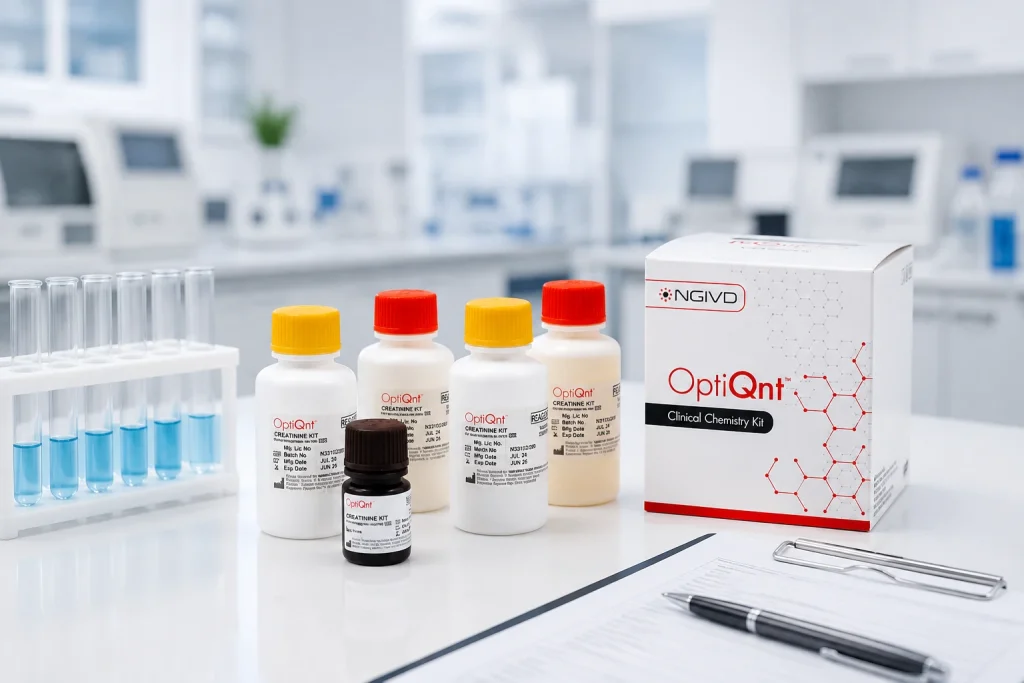
NGIVD manufactures its OptiQnt clinical chemistry reagent kits at its ISO 9001:2015, ISO 14001:2015, ISO 13485:2016 and cGMP-certified facility in IMT Manesar, Haryana, with in-house R&D and manufacturing across multiple production lines — backed by support from BIRAC and the Department of Biotechnology. For labs and distributors working through the checklist above, that means batch documentation, regulatory compliance, and application support are already built into the relationship from the first conversation.
If you’re currently evaluating reagent suppliers, explore the Clinical Chemistry range or get in touch with the NGIVD team to discuss your analyser compatibility and volume requirements.
Frequently Asked Questions (FAQs)
1. What certifications should a clinical chemistry reagent supplier have in India?
At minimum, valid CDSCO registration for the reagents being sold, ISO 13485:2016 certification for the manufacturing quality system, and cGMP compliance at the production facility. ISO 9001 and ISO 14001 are useful additional signals of overall quality and environmental management maturity.
2. How do I know if a reagent will work on my existing analyser?
Ask the supplier for validated application parameter sheets specific to your analyser model, and ideally speak to another customer already running that reagent successfully on the same platform. Don’t assume compatibility just because a reagent is labeled as open-system.
3. What is a certificate of analysis (CoA) and why does it matter?
A CoA documents the quality-control results for a specific reagent batch before it’s released for sale. Requesting a CoA per lot lets you verify batch-to-batch consistency yourself rather than relying solely on the supplier’s assurance.
4. Is it worth switching reagent suppliers to save money on a per-kit basis?
Only after accounting for the full picture — validation time for the new reagent, any recalibration required, and the risk of batch inconsistency during the transition. A modest per-kit saving can be outweighed by the hidden cost of switching if quality data and support aren’t equally strong.
5. What should distributors specifically ask a reagent manufacturer?
Beyond the standard quality checks, distributors should clarify private-labeling or customization options, margin structure at different volumes, marketing and training support, and how technical complaints from end customers get resolved and communicated back.
6. How often should batch quality be re-verified after choosing a supplier?
Running a quick control check on each new lot as it arrives — rather than assuming consistency indefinitely — is good practice regardless of how established the supplier relationship is. It catches the rare off-spec batch before it affects patient results.