
Healthcare is evolving rapidly, and diagnostic technology is playing an increasingly important role in this transformation. From identifying diseases at an early stage to supporting more informed treatment decisions, modern diagnostic solutions are helping healthcare professionals understand health conditions with greater clarity. But what will the next generation of diagnostics look like?
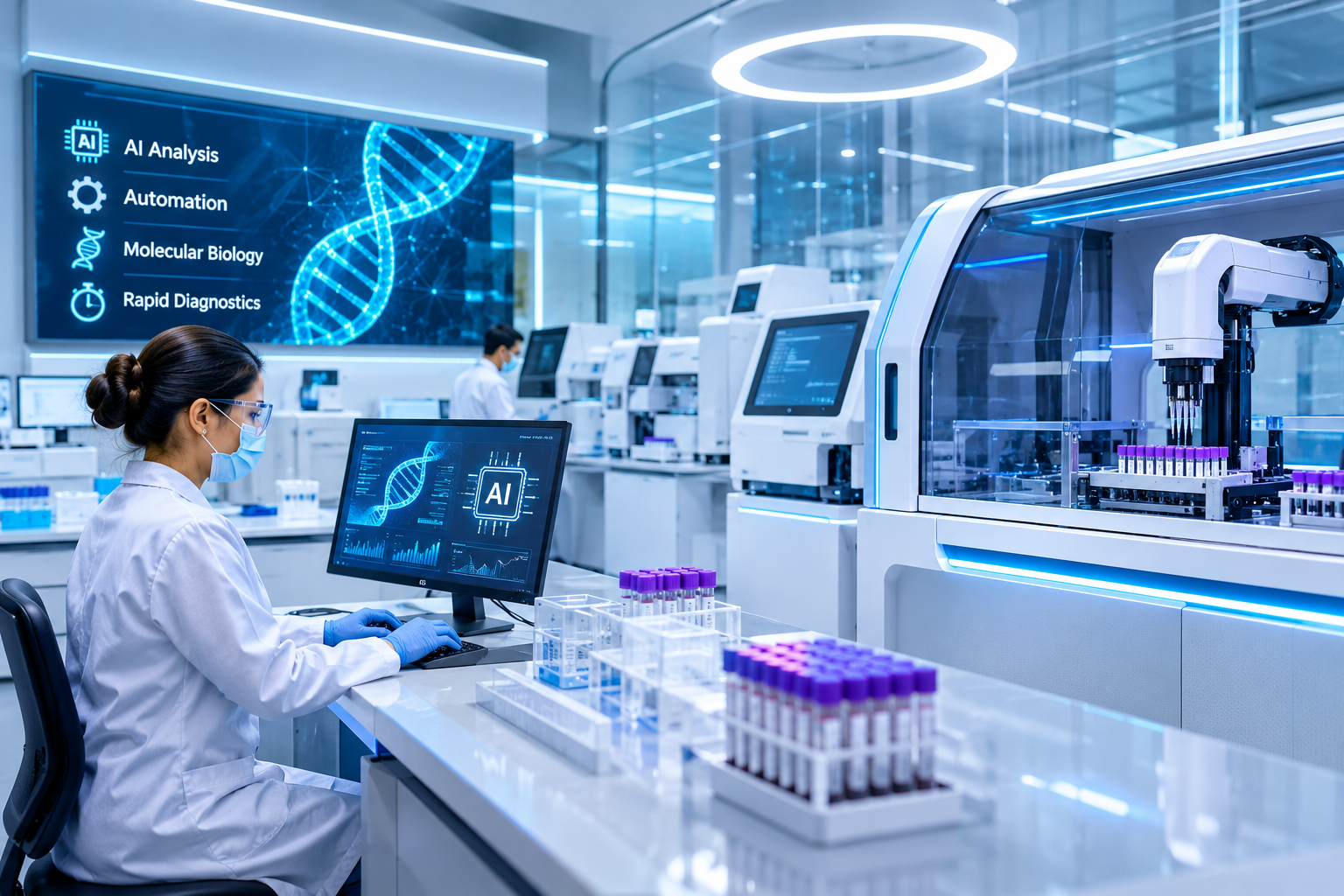
Three major technologies are shaping this future: Artificial Intelligence (AI), laboratory automation and molecular biology. Together, they are changing how diagnostic laboratories process samples, analyse information and detect diseases.
These developments are not just about introducing advanced machines or digital tools. They are about building diagnostic systems that are more efficient, reliable, accessible and responsive to the changing needs of healthcare. For diagnostic laboratories, hospitals, healthcare providers and the In-Vitro Diagnostics (IVD) industry, understanding these changes is becoming increasingly important.
Let’s explore how these technologies are shaping the future of diagnostics.
1. Artificial Intelligence: Making Diagnostics Smarter
Artificial Intelligence, commonly known as AI, refers to computer systems that can analyse information, identify patterns and support decision-making. In healthcare, AI is increasingly being explored and applied in areas such as medical imaging, pathology, clinical data analysis and disease screening.
Traditionally, diagnostic professionals have relied on their expertise, established testing procedures and laboratory instruments to interpret results. AI-based tools can add another layer of analytical support by processing large volumes of information and identifying patterns that may be difficult to recognise manually.
How is AI transforming diagnostic testing?
1. Faster analysis of diagnostic information
AI-based software can process large datasets and assist in identifying patterns in medical images, laboratory records and other diagnostic information. This can help healthcare professionals review information more efficiently.
2. Supporting early disease detection
Some AI applications can assist in identifying patterns associated with specific health conditions. For example, computer-aided detection tools are being developed to support the screening and identification of people who may require further diagnostic evaluation.
3. Improving laboratory data management
AI can help organise and analyse laboratory data, identify unusual trends and support quality-monitoring activities. When appropriately validated, such tools may help laboratories identify issues that need further investigation.
4. Supporting clinical decision-making
AI can combine different types of information and provide analytical support to healthcare professionals. However, it should complement—not replace—professional judgement and established clinical procedures.
AI in the future of diagnostic laboratories
In the coming years, AI is expected to become more closely integrated with laboratory information systems, diagnostic instruments and digital healthcare platforms. Possible applications include automated result review, quality-control monitoring, workflow optimisation and predictive maintenance of laboratory equipment. However, AI systems must be carefully evaluated before clinical use. Their performance depends on the quality and representativeness of the data used to develop and validate them. Human oversight, patient privacy, transparency and regulatory compliance remain essential. The World Health Organization (WHO) has highlighted the importance of ethical governance and responsible implementation of AI in healthcare.
2. Laboratory Automation: Improving Speed, Consistency and Efficiency
As diagnostic testing requirements increase, laboratories need ways to manage higher workloads without compromising testing quality. This is where laboratory automation becomes important. Laboratory automation involves using instruments, equipment and software to perform repetitive testing and sample-handling activities with reduced manual intervention. Instead of depending entirely on manual processes, laboratories can use automated systems to improve workflow consistency and manage testing more efficiently.
How does laboratory automation improve diagnostics?
1. Reduces repetitive manual work
Automated analysers can perform routine testing procedures, reducing the amount of repetitive work required from laboratory personnel.
2. Supports consistent testing processes
Standardised instrument-based procedures can help reduce variations associated with manual handling, provided the equipment is correctly maintained and quality-control procedures are followed.
3. Helps manage higher sample volumes
Automated systems can support laboratories that process large numbers of samples every day. This is particularly useful for hospitals, diagnostic chains and high-volume laboratories.
4. Supports faster turnaround times
Automation can reduce delays in selected stages of laboratory testing, including sample handling, analysis and result processing. The actual improvement depends on the test, instrument and overall laboratory workflow.
5. Improves laboratory resource utilisation
By reducing repetitive tasks, automation allows trained laboratory professionals to focus more on quality assurance, troubleshooting, result review and other specialised responsibilities.
The growing role of diagnostic analysers
Diagnostic analysers are an important part of laboratory automation. Modern analysers are designed to perform specific testing functions with greater consistency and efficiency. Depending on the instrument, they may offer automated sample processing, multiple testing parameters, digital displays, result storage and integrated data management.
Some important areas where automation is making a difference include:
- Clinical Chemistry: Automated analysis of biochemical parameters such as glucose, cholesterol, liver function and kidney function markers.
- Haematology: Automated blood cell counting and analysis through haematology analysers.
- Immunology: Instrument-based testing for specific antigens, antibodies and other biological markers.
- Molecular Diagnostics: Automated nucleic acid extraction and molecular testing workflows.
- Point-of-Care Testing: Compact diagnostic systems that bring selected tests closer to the patient.
The future will not necessarily mean that every laboratory needs a fully automated facility. Smaller laboratories may benefit more from selecting specific automated instruments that address their workload, testing requirements and available resources. The objective is to choose the right level of automation for the laboratory.
3. Molecular Biology: Taking Disease Detection to a Deeper Level
One of the most significant developments in modern diagnostics is the growing importance of molecular biology. Traditional diagnostic methods often identify diseases by detecting changes in cells, proteins, antigens or antibodies. Molecular diagnostic techniques take a different approach by examining genetic material such as DNA and RNA. This allows laboratories to detect specific genetic sequences associated with infectious organisms, inherited conditions and other biological changes.
What is molecular diagnostics?
Molecular diagnostics refers to laboratory techniques used to detect or analyse specific DNA or RNA sequences in a biological sample. One of the best-known molecular techniques is Polymerase Chain Reaction (PCR). PCR amplifies selected genetic material, making it easier to detect specific DNA sequences. Reverse Transcription PCR (RT-PCR) first converts RNA into complementary DNA before amplification, allowing the detection of RNA targets. These techniques have important applications in infectious disease testing, genetic analysis and research.
Important molecular biology technologies
1. Polymerase Chain Reaction (PCR)
PCR is a widely used molecular technique that amplifies specific DNA sequences. It is used in various applications, including infectious disease testing and genetic research.
2. Real-Time PCR (qPCR)
Real-Time PCR monitors the amplification process as it occurs. Depending on the assay design, it can help detect and quantify specific genetic targets.
3. Reverse Transcription PCR (RT-PCR)
RT-PCR is used when the target genetic material is RNA. The RNA is converted into DNA before amplification, making the technique useful for detecting RNA viruses and other RNA targets.
4. Nucleic Acid Extraction
Before molecular testing, DNA or RNA generally needs to be separated from the sample and purified. Nucleic acid extraction is therefore a critical step in the molecular diagnostic workflow.
Two commonly used extraction approaches are:
- Silica spin column technology: Uses a silica-based membrane to bind nucleic acids during the purification process.
- Magnetic bead technology: Uses magnetic particles to capture nucleic acids, allowing separation and purification through magnetic handling.
The selection of an extraction method depends on sample type, testing requirements, throughput, equipment and workflow.
5. Next-Generation Sequencing (NGS)
NGS allows researchers and specialised laboratories to analyse large amounts of genetic information. It has applications in genomics, infectious disease research, cancer research and the investigation of genetic variations.
Why is molecular diagnostics important for the future?
Molecular testing can help identify specific pathogens and genetic targets that may not be detected through other testing approaches.
Its applications include:
- Infectious disease detection
- Identification of selected genetic variations
- Research into inherited conditions
- Detection of antimicrobial resistance markers
- Cancer-related molecular analysis
- Epidemiological and public health research
The World Health Organization continues to evaluate and recommend different molecular testing approaches for specific diseases and healthcare settings. Developments in near-point-of-care nucleic acid amplification testing also show how molecular testing may become more accessible beyond specialised laboratories.
The choice of molecular test must always depend on the clinical purpose, validated performance, applicable guidelines and the manufacturer’s intended use.
4. The Convergence of AI, Automation and Molecular Biology
The most exciting development may not be any one of these technologies in isolation. It is the way they can work together. Imagine a modern diagnostic laboratory where automated systems manage sample processing, molecular platforms detect specific genetic targets, and digital tools help organise and analyse the resulting information.
Each technology contributes a different capability:
| Technology | Its contribution to diagnostics |
|---|---|
| Artificial Intelligence | Analyses data and supports pattern recognition and decision-making |
| Laboratory Automation | Streamlines repetitive processes and supports consistent workflows |
| Molecular Biology | Enables the detection and analysis of specific genetic material |
| Digital Integration | Connects instruments, laboratory information and reporting workflows |
Together, these technologies can help create a more connected diagnostic ecosystem. For example, an automated molecular testing workflow may handle sample preparation and testing, while laboratory software manages test information and results. Validated analytical tools may then assist with data review or quality monitoring. However, integration alone does not guarantee better outcomes. Each component must be validated, compatible with the overall workflow and supported by appropriate quality-management practices.
5. Point-of-Care Testing: Bringing Diagnostics Closer to People
Another important direction in diagnostics is the expansion of Point-of-Care Testing (POCT). Traditionally, many diagnostic tests have required samples to be collected and transported to centralised laboratories. POCT aims to make selected tests available closer to the patient, including hospitals, clinics, healthcare centres and other suitable testing locations. Rapid diagnostic kits and compact testing instruments are examples of technologies that can support this approach.
Why is POCT gaining importance?
- Convenience: Testing can be performed closer to where healthcare is delivered.
- Timely information: Selected tests can provide results without the need for lengthy sample transportation.
- Broader access: Appropriate testing solutions can support healthcare delivery in areas with limited laboratory infrastructure.
- Clinical support: Faster access to test information can help healthcare professionals make timely decisions.
POCT does not replace the need for central laboratories. Different tests have different performance characteristics, infrastructure requirements and clinical applications. The right testing method should be selected according to the intended purpose and relevant guidelines.
The future may bring greater integration between rapid testing, compact molecular platforms and digital result-management systems.
6. Personalised and Precision Diagnostics
Healthcare is gradually moving towards approaches that consider the individual characteristics of each patient. This is where precision diagnostics becomes increasingly relevant. Instead of relying only on general indicators, precision diagnostics uses information such as genetic variations, molecular markers and other biological data to support a more detailed understanding of disease.
Molecular biology is an important part of this development. For example, genetic and molecular testing can help identify specific variations associated with certain conditions. In cancer care, molecular analysis may help identify biomarkers that support treatment selection for eligible patients.
AI and advanced data analysis may further help researchers and healthcare professionals interpret complex biological information. Although precision diagnostics offers significant potential, its application depends on validated tests, clinical evidence, appropriate interpretation and access to suitable technologies.
7. The Future of Diagnostics in India
India’s healthcare ecosystem is expanding, and diagnostic laboratories are an essential part of this growth. The demand for accessible, timely and reliable testing creates opportunities for manufacturers, laboratories, hospitals, distributors and technology developers. However, the future of diagnostics in India will depend on more than introducing advanced technology. It will also require solutions that are practical, affordable, scalable and suitable for different healthcare settings.
Some important developments to watch include:
1. More accessible diagnostic technologies
Compact analysers, rapid test kits and suitable point-of-care solutions can help extend testing access across different healthcare settings.
2. Growth in molecular testing
PCR, nucleic acid extraction and other molecular biology technologies are expected to remain important in infectious disease testing, research and specialised diagnostics.
3. Increased laboratory automation
Laboratories may increasingly adopt automated analysers and integrated workflows to manage testing volumes and improve operational efficiency.
4. Digital integration
Better connectivity between diagnostic instruments, laboratory information systems and healthcare platforms can support more organised data management and reporting.
5. Stronger focus on indigenous manufacturing
Domestic research, product development and manufacturing can contribute to the availability of diagnostic solutions suited to Indian healthcare requirements.
6. Greater emphasis on quality and validation
As diagnostic technologies become more advanced, quality management, performance evaluation, regulatory compliance and reliable manufacturing will remain essential.
For India, the opportunity lies in combining technological innovation with affordability, accessibility and strong manufacturing capabilities.
8. Challenges That the Diagnostics Industry Must Address
While these technologies offer significant opportunities, their adoption also comes with challenges.
- Cost of technology: Advanced instruments, software and infrastructure can require substantial investment. Smaller laboratories may need affordable and scalable options.
- Data security and privacy: AI-based diagnostic systems and connected laboratory platforms may handle sensitive health information. Appropriate safeguards and data-governance practices are essential.
- Training and technical expertise: Laboratory professionals need suitable training to operate advanced instruments, manage digital systems and understand new testing methods.
- Quality assurance: New technologies must be evaluated and validated to ensure that they perform reliably for their intended applications.
- Infrastructure and accessibility: Reliable electricity, internet connectivity, maintenance support and supply chains can influence technology adoption, particularly in resource-limited settings.
- Regulatory compliance: Diagnostic products and software must meet applicable regulatory requirements and be used according to their approved or stated intended purpose.
Addressing these challenges will be important to ensure that innovation translates into meaningful improvements in diagnostic services.
9. How NGIVD Is Contributing to the Evolving Diagnostics Ecosystem
At NGIVD, the focus is on developing and manufacturing diagnostic products and clinical diagnostic solutions that support the changing requirements of laboratories and healthcare providers. Through research, product development and manufacturing, NGIVD works across multiple areas of the In-Vitro Diagnostics industry.
Its product portfolio includes solutions in:
- Clinical Chemistry: Reagents and diagnostic solutions for routine biochemical testing.
- Rapid Testing: ViuFlo rapid test kits for selected infectious disease and other testing applications.
- Molecular Biology: Products supporting molecular biology workflows, including nucleic acid purification and sample preparation.
- Diagnostic Analysers: Instruments designed to support laboratory testing requirements.
- Point-of-Care Testing: Diagnostic solutions designed for suitable testing settings.
NGIVD’s molecular biology portfolio includes isoPwr-S silica spin column-based and isoPwr-M magnetic bead-based nucleic acid purification solutions. These products are listed for Research Use Only (RUO), and their use should follow the stated product labelling and intended purpose. The company also focuses on in-house research and development, manufacturing capabilities and quality systems to support the development of diagnostic solutions. As the diagnostics industry continues to evolve, NGIVD remains focused on its guiding philosophy: Bridging Science for Better Health.
Explore NGIVD’s diagnostic products and solutions to learn more about its portfolio.
10. What Will the Diagnostic Laboratory of the Future Look Like?
The diagnostic laboratory of the future will likely be more connected, technology-enabled and data-driven. It may combine automated analysers, molecular testing platforms, digital laboratory management and carefully validated AI-based applications. Some laboratories will adopt highly integrated automation systems, while others will use a combination of specialised instruments suited to their testing volumes and budgets. The most important change will be the shift towards smarter and more coordinated diagnostic workflows.
Technology will continue to evolve, but the fundamentals of reliable diagnostics will remain the same: quality samples, validated testing methods, trained professionals, appropriate quality control and accurate reporting.
Conclusion: A Smarter Future Begins with Better Diagnostics
The future of diagnostics is being shaped by the combined potential of artificial intelligence, laboratory automation and molecular biology. AI can support the analysis of complex information. Automation can help laboratories manage workflows more efficiently. Molecular biology can provide deeper insights by detecting specific genetic material. Together, these technologies are creating new possibilities for diagnostic laboratories, healthcare providers and the wider IVD industry.
For manufacturers, the opportunity is to develop reliable, innovative and accessible solutions that meet the evolving needs of healthcare. For laboratories, it is to adopt the right technologies while maintaining quality and operational discipline. Ultimately, the goal is not simply to make diagnostics more advanced. It is to make reliable diagnostic information more accessible and useful for better healthcare decisions.
The future of diagnostics is not just about better technology. It is about making better healthcare possible.
Frequently Asked Questions (FAQs)
1. What is the future of diagnostics?
The future of diagnostics is expected to involve greater use of artificial intelligence, laboratory automation, molecular biology, digital integration and point-of-care testing to support more efficient and accessible diagnostic services.
2. How is AI used in diagnostic laboratories?
AI can assist with analysing diagnostic data, identifying patterns, supporting quality monitoring and organising laboratory information. Its use depends on the application, validation and appropriate human oversight.
3. What is the role of automation in diagnostic testing?
Laboratory automation helps perform repetitive testing and sample-handling activities with reduced manual intervention. It can support workflow consistency, testing capacity and turnaround-time improvements.
4. Why is molecular diagnostics important?
Molecular diagnostics can detect specific DNA or RNA sequences. Techniques such as PCR and RT-PCR are used in applications including infectious disease testing, genetic analysis and molecular research.
5. What is the difference between PCR and molecular diagnostics?
Molecular diagnostics is a broader field that includes different methods of analysing genetic material. PCR is one specific technique used to amplify selected DNA sequences, while RT-PCR is used for RNA targets after conversion into DNA.
6. Will AI replace laboratory professionals?
AI is more appropriately viewed as a tool that can support laboratory professionals. Human expertise remains essential for quality assurance, result interpretation, troubleshooting and clinical decision-making.
7. What is the role of IVD manufacturers in the future of diagnostics?
IVD manufacturers contribute by developing and producing diagnostic kits, reagents, analysers and related technologies. Their focus on research, quality, manufacturing and product innovation helps support the evolving requirements of healthcare.
8. How will diagnostics evolve in India?
The Indian diagnostics sector is expected to see continued interest in affordable diagnostic technologies, molecular testing, automation, point-of-care solutions, digital integration and domestic manufacturing capabilities.